
Showing posts with label Malawi. Show all posts
Showing posts with label Malawi. Show all posts


10% Internet levy in Malawi - a step backward
Sunday, May 24, 2015
It never rains but pours for us, Internet users in Malawi. While grappling under one of the most expensive telecommunication tarrifs in the world, the government has decided to introduce a 10% levy on Internet, SMS and other data transfer services. In 2013, the government already introduced a 16.5% Value Added Tax (VAT) on Internet services. Apparently the Minister of Finance, in his 2015/2016 budget presentation argues that there has been a "tremendous uptake" of telecommunication services in the country hence the need to increase the tax base through this avenue to finance the zero-aid national budget from local resources. Statistics, however, show otherwise. According to a report by BuddeComm, by the end of 2014, the market penetration rates for telecom services in Malawi were 36% for mobile telephony, 1.9% for fixed telephone services and 6.1% for Internet services. It is clear that there is no tremendous uptake of telecom services in Malawi particularly for Internet services. It is thus a step backward to introduce levies that will stifle the already paltry Internet uptake in Malawi. In this post, I dwell much on how Internet access can promote trade and entrepreneurship in a country like Malawi.
Technologies like the Internet have been shown to promote trade and entrepreneurship even in developing countries as the Internet provides a platform through which manufacturers and service providers can showcase their products and services to a global audience. For example, a tourist attraction whose information has been put online is likely to attract a stream of international tourists. Companies and organizations which have an online presence clearly expose themselves to a larger market audience. This is also true for small and medium enterprises. Simply put, an online presence is a must for any progressive enterprise. Stifling Internet access through Internet levies is therefore a clear contradiction to the policy of promoting trade and entrepreneurship in the country. For further reading, a 2006 paper by Clarke & Wallsten provides insights on the linkages between trade and Internet usage.
The Internet has also provided self-employment among enterprising youths in Malawi. With the prevalent high unemployment rates in the country, some youths have taken advantage of the many opportunities provided by the Internet through businesses like website development, internet cafés, computer networking, etc. With the rising costs in Internet access, many of these businesses will be less patronized hence threatening their very existence. Where is the much touted youth empowerment then?
It is also a fact that an increasing number of Malawians are looking at the Internet as a source of vital information on education, current affairs, business, etc. For example, on the online business directory we are running, Biz Directory MW, we get not less than 100 page views per day with most traffic emanating from search engines such as Google and Bing. And 80% of all search queries come from within Malawi. This empirically demonstrates that many Malawians are increasingly using the Internet as a source of non-trivial information such as business information. Again, we can see that access to the Internet is something that should be encouraged to stimulate entrepreneurship in the country.
Other countries like Rwanda have put technology at the heart of their development strategies and the results are there for all to see. Lets build a Malawi that can escape from the shackles of poverty through progressive policies. Affordable Internet access is a need and not a want.
Read more...
Online Short Courses - B4C Software Engineering Consultants - Malawi
Sunday, January 20, 2013
For the first time in Malawi, B4C Software Engineering Consultants are offering online short courses in various computing fields at http://moodle.b4csoftware.com/
Read more...A Pictorial Tribute to late President Prof. Bingu wa Mutharika of Malawi
Friday, April 13, 2012
 5th April, 2012 shall be a day that shall have an indelible mark to many Malawians including myself. It was the day that the President of Malawi, Professor Bingu wa Mutharika died. Personally, I felt the sadness that I have never felt before when I learned that the President had collapsed at around 11.15am the same day. It was a shock to many!
It is thus with that sadness that I present this pictorial tribute in honour of the late Professor Bingu wa Mutharika. As any person born through Adam, any human (including you and me) have weaknesses but nevertheless Bingu wa Mutharika shall remain a hero to me and indeed will be remembered as a great son of Africa. There are several reasons why Bingu shall always remain a hero to me and I guess even to other Malawians and Africans in general.
I find the life of Bingu wa Mutharika as a President (from 2004-2012) to be very inspiring. Bingu wa Mutharika inculcated in Malawians the spirit of self-sufficiency and self-confidence. This he demonstrated through the so many development projects that he initiated in the spirit of having a Malawi that is not perpetually donor dependent. His argument has always been that Malawi has been 'independent' from colonialism since 1964 (2012 marks 48 years of 'independence'). However, Malawi has perpetually remained one of the poorest countries in the world yet Malawi is rich in several natural resources such as fertile land, fresh water and indeed untapped mineral resources.
It is against this background that the late President always promoted home-grown policies as a way of taking Malawi out of the quagmire of poverty. He thus initiated several tangible development projects that saw poverty levels decline from 60% in 2004 to 40% in 2010. I now present some pictures capturing some of the development projects initiated by the Prof. Bingu wa Mutharika through his 'home-grown policies':

Coupled with good rains, Malawi has witnessed a highly successful fertilizer subsidy programme from 2004 that has made Malawi food-sufficient.


By creating diplomatic relations with China under Prof. Bingu wa Mutharika, Malawi has witnessed tangible Chinese funded development projects including the magnificent Parliament Building in Lilongwe, the capital of Malawi

After waiting for over 40 years, the people of the 'remote' district of Chitipa finally are also now having a tarmac road courtesy of Bingu's development agenda.


The Malawi University of Science and Technology now under construction is also brainchild of the late Prof. Bingu wa Mutharika.

Late Bingu wa Mutharika demystified the myth that Malawi had no mineral resources. Kayelekera uranium mine, opened during the Bingu's presidency, was the first significant international mining investment in Malawi
Malawians - are you tired of computer viruses?
Sunday, April 01, 2012
Fellow Malawians!
Are you tired of computer viruses on your computer? Its time to make a switch to Ubuntu Linux, a free and open source operating system that can completely change your computing experience:
- Ubuntu Linux is free (no need to buy it or use pirated ('stolen' software)).
- Ubuntu Linux is user-friendly just as Microsoft Windows.
- You 'forget' about computer viruses when you use Ubuntu Linux.
- Malawi as a country in general can save a lot of the much needed forex if people can switch to Linux (its free software and no need to buy expensive anti-viruses which unnecessarily increases our already bloated import bill)
- Companies and other institutions can substantially save on their IT budget if they can switch to Ubuntu Linux (its free software and no need to buy expensive anti-viruses)
- Installation is easy and you can do side by side installation with Microsoft Windows so that you can try Ubuntu Linux while still having your Microsoft Windows intact.
You can get your free copy of Ubuntu Linux (in Blantyre) by calling on 01988998, 0991451553, 0884188893, 0999111736, 0888585707. You may also contact any member of the Blantyre Free and Open Source Users group - http://groups.google.com/group/blantyrefossusers
Also feel free to share your copy of Ubuntu Linux with all. Its not illegal to do so because this is free and open source software.
Please help to spread this word by letting as many people as possible to know about this.
Yours in Service,
Bennett Read more...
B4C Software Engineering launches website
Thursday, July 07, 2011
B4C Software Engineering, a Malawian registered firm that specializes in the provision of quality software engineering solutions to business entities and organizations in Malawi and beyond, has launched a new website at http://www.b4csoftware.com/
Read more...Seminar on 'Reporting Africa' for Malawian media practitioners
Sunday, June 05, 2011
There is an announcement of a seminar on 'Reporting Africa' for Malawian media practitioners to be held at the Posts Conference Centre in Blantyre in Malawi on 16th June 2011.
Some of the specific objectives of the seminar include: to explore problems and prospects of representing Africa in local and international media; and to equip media workers with skills for representing Africa positively in local and international media without compromising professional media ethics and the integrity of Africans.
Targeted participants for the seminar are media professionals such as reporters, announcers, presenters, editors, directors, producers, script regulators, and trainers, etc
More details of the seminar can be accessed at http://www.pcmconsultants.com/reporting-africa-seminar.html
Malawi's maize green revolution but ...
Monday, January 03, 2011
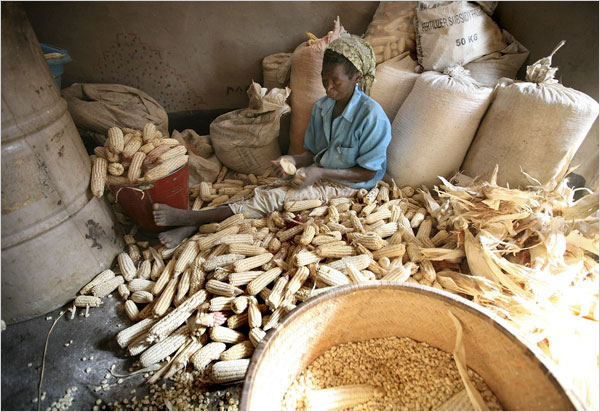
Malawi is basking in an unprecedent maize green revolution. Even in normally lean months like January, maize which is the staple food is readily found in common markets at the unusually average price of 2000 Malawi Kwacha (about 12 US dollars) per 50 kg bag. Normally at this time of the year maize becomes relatively scarce and prices double.
This success is attributed to mainly two factors: the fertilizer subsidy programme championed by the Malawi government under the leadership of Prof. Bingu wa Mutharika and the promotion of irrigation under the Malawi Green Belt initiative which has seen Malawians harvesting maize twice (ie from the normal rain dependent farming season and irrigation based dry season harvest). As a Malawian, I am very proud that the days of hunger in the country are gone. God gave Malawians so many perennial rivers and we Malawians have realised that the rivers we have can be put to optimal use to combat hunger in the country, thanks to President Mutharika's vision of Malawi Green Belt Initiative.
Others have talked about the sustainability of the maize subsidies but for me my major concern is the nutrition value of maize. I am not a nutrition expert but based on my readings in literature, it is well documented that maize is lower in nutritive value than other foods like bananas, cowpeas (nandolo in Malawian vernacular), etc. Malawians traditionally believe that they have eaten when they have eaten a maize flour based food known as nsima. Unfortunately this food is just starch which just provides calories. It therefore my prayer that the government of Malawi to embark on maize nutrition fortification initiative to improve the nutrition status of our highly valued staple, maize. It should be a requirement that all the maize flour sold on the markets should be fortified with right amounts of minerals and vitamins. It is already being enforced that all salt sold on the market is fortified with iodine. So we can also adopt a similar approach to maize flour.
The following excerpt from the Food and Agricultural Organization website regarding maize diets caught my attention:
"In nutritive value maize is quite similar to other cereal grains. In fact, it is somewhat superior to wheat flour and only to a small extent below rice. These are the three cereal grains most consumed by people throughout the world. The problem with maize lies in the diet of which it is a component, a diet mostly deficient in the kind of supplementary foods necessary to upgrade the nutrients ingested in relatively large amounts of maize. Maize-consuming populations would be nutritionally better off if the maize consumed had the lysine and tryptophan genes of QPM or if it were consumed with a sufficient amount of protein foods such as legumes, milk, soybeans and amaranth seeds and leaves. This, however, will not occur in the near future, and therefore other measures should be taken. In this section, a number of possibilities, the results of studies to improve the nutritional quality of maize-based diets, are presented."
More at http://www.fao.org/docrep/t0395e/T0395E0c.htm
Malawi holds a youth conference on climate change
Sunday, November 28, 2010
Malawi successfully held a youth conference on climate change for southern Africa from 18th to 20th November 2010 at Cresta Crossroads Hotel in Lilongwe.
The conference website is at http://www.sayccc.org/
MAKNET - a discussion platform for Malawi launched!
Tuesday, September 21, 2010
The Malawi Knowledge Network for Trade, Policy Research and Development (MAKNET) has a website at http://www.maknet.org.mw/ where development issues affecting Malawi are debated! Registration is free for all interested individuals!

A new software development firm is born in Malawi
Wednesday, April 28, 2010
A new software development firm known as B4C Software Engineering has just been established in Malawi. The firm's website is http://www.b4csoftware.com/
The company now specializes in the development of custom enterprise software, user experience design, systems integration, software maintenance and support.
Of foreign adoptions and the Day of the African Child
Tuesday, June 16, 2009
Today, its 16th June, a day in which we celebrate the life of an African child. Originating from remembering the massacres of the innocent children in Soweto, South Africa in 1976, we now reflect on the plight of the African child. Indeed we now reflect on the need of the African child to have access to quality education, health, protection against abuse etc. This is because the future of our beautiful African continent lies in the hands of the African child.

In this post, I would like to share my thoughts of having western 'celebrities' come to Africa to adopt our orphans and vulnerable children. In particular, I would like to refer to a case in which Madonna has been allowed to adopt another child in Malawi. I do not wish to hide that I am one of the many Malawians who are not happy with this decision.
Imagine if all our orphaned children were put up for foreign adoption, what would become of their destiny and indeed the destiny of Africa at large? Obviously as Africans we have our own culture and traditions that can not just simply be ignored for material prosperity in a foreign adopted home. Much as we appreciate that a child needs material care, we can also not ignore the need to protect the African identity of the child. If at all, one is interested in the welfare of African children, the solution is not to just pick one or two kids out of the many thousands of orphaned children out there! What is wrong with helping the kids while the kids are right here in Africa like what Oprah Winfrey does? This idea of 'fishing out a single kid' out of Africa as what Madonna is doing can simply be rated as 'media charity'.
A question then pops up in my mind! Is it that as Africans we have failed to take care of our African children? Maybe we can say so? How? It is very surprising that these kids being put up for foreign adoption are being found in orphanages. If not mistaken, this orpanage syndrome is a new phenomenon across Africa. Why do I say so? Normally, in an African communalistic setting, one is supposed to take care of relatives children as if they are your own children. So even if a parent dies, the relatives of the deceased are supposed to take care of the children. But what do we see now? Relatives quickly send the orphaned children to orphanages. This is why there are so many children in the orphanages now.
Where has our African Umunthu spirit gone? Is this a sign that African cultural values are being eroded? In addition to this, we should go back to our African traditional values that always insist that those who are mature enough are the ones who should get married and have children who they can manage to take care of. Otherwise, we shall keep on having problems of children who lack parental care. Read more...
Picture of victorious Bingu wa Mutharika and Joyce Banda
Tuesday, May 26, 2009

Photo of Bingu wa Mutharika and Joyce Banda during the gruelling 2009 Malawi General Election campaign. Bingu became triumphant with over 65% of the votes cast by a huge turnout of Malawian voters. His party the Democractic Progressive Party (DPP) has more than 114 seats in the 193 seat Malawi Parliament. Congratulations Dr Bingu!
Bravo to the Ministry of Local Government in Malawi!
Thursday, March 19, 2009
The Ministry of Local Government and Rural Development in Malawi recently launched their website. The url of the website is http://www.mlgrd.gov.mw/.
I followed the official launch of the website through Zodiak Broadcasting Station, one of the most vibrant private radio stations in Malawi. To the Ministry of Local Government in Malawi, I say keep it up! In fact, other government ministries in Malawi should follow this good example. Nowadays, we can never underestimate the power of posting information on the Web!
Finally we have fuel price cuts in Malawi...
Monday, February 02, 2009
I can't contain my joy that finally the government of Malawi has reduced fuel (gas) prices effective 1st February, 2009. While the rest of the world was enjoying fuel price cuts on the world market, Malawians were still being pinned to the wall!
The new fuel prices charged per litre are as follows: Petrol charges have been cut from MK251.20 (US$1.75) to MK213.50 (US$1.50), diesel was at MK234.50 (US$1.65) and is now at MK199.30 (US$1.40), while kerosene (or paraffin) was at MK165.30 (US$1.16) and is now selling for MK132.20 (US$0.93).
On a personal note, I use an automatic transmission car (a Toyota Ipsum Picnic) and I must say that somehow it consumes more fuel than my previous manual Mitsubishi RVR sports gear. I do not know if there is any scientific evidence that automatics consume more fuel in comparison to manuals. But my instincts are indicating that automatics may be fuel guzzlers!
In general, as Malawians we also expect a reduction in costs of transport, food etc. This is because in Malawi increase in fuel prices automatically trigger a corresponding increase in prices of essential goods and services. Moreover, as consumers in Malawi we have a right to demand a corresponding decrease in prices of goods and services this time around. That is if our businessmen, especially minibus owners, are honest enough!
Finally bravo to all civil society organizations in Malawi for fighting tooth and nail for the common Malawian to have this fuel price cut!
Short Course on Advanced Computer Skills for Scientists in Malawi
Wednesday, January 28, 2009
I thought I should share the following information with fellow scientists in Malawi:
The Department of Mathematics & Statistics at Malawi Polytechnic, a constituent college of the University of Malawi is pleased to announce a short course under the theme "Advanced Computer Skills for Scientists in Malawi". The course has been designed to equip Malawian scientists with necessary skills in this modern world of computer technology. The course runs for five days from 23rd February 2009 to 27th February, 2009.
Some of the content for the course include:
- Scientific information in the Digital Age
- An African scientist in a dynamic scientific world
- Scientific document preparation using LaTex and BibTex tools
- Advanced internet search skills for scientific research work
- Utilizing digital libraries for scientific research work
- Collaborative networking techniques with fellow scientists around the world
- Scientific Talk presentation: Microsoft PowerPoint vs. the Latex Beamer class
- Using weblogs to disseminate scientific information and improve scientist profile
- An overview of scientific computer packages
Course fees: MK40000.00 including lunch and snacks. However the fee does not include accommodation.
For more information email maths (at) poly.ac.mw or phone 04188893/09771807/08747059 Read more...
Announcing a Secondary School Mathematics Software Package for Malawi ...
Monday, January 26, 2009
Alinune Musopole, an undergraduate student in the Bachelor of Science degree in Mathematical Sciences Education programme at the Malawi Polytechnic, a constituent college of the University of Malawi, has developed a mathematics software package for secondary schools in Malawi as his final year project. As with the localized word processor project by Edmond Kachale, I also share with you esteemed blog readers a synopsis of this project. Also watch out this blog for more featured projects!
Project Title: A Secondary School Mathematics Software Package for Malawi
Project Author: Alinune Musopole (nune_musopole (at) yahoo.co.uk)
Project Supervisor: Bennett Kankuzi (bfkankuzi (at) gmail.com)
Project Location: Dept of Mathematics & Statistics, Polytechnic, University of Malawi
Abstract:
There are many challenges that secondary school students in Malawi are facing in the learning of Mathematics in Malawi. Examples of these problems are lack of confidence, lack of practice and lack of motivation by students.
One of the ways through which problems faced by secondary school students in the learning of Mathematics can be alleviated is the use of the computer. Computer software, particularly Mathematics software packages, can help reduce problems faced by students in the learning of Mathematics in Malawi as practicing tools, hence we developed a software package that shall be used by secondary school students in the practicing of Mathematics. The software package is based on the Malawi Senior Secondary School Mathematics curriculum and the package is called a Computer Package for Secondary School Mathematics (CPSSM) for Malawi.
The algorithms and user interface for the program have been implemented using a Turbo C++ compiler and the Object Windows Library (OWL).
*****
An executable of the project can be requested via the given emails. Full LaTex and pdf reports of the project can also be requested via the same.
*****
Software testing services in Malawi
Monday, December 22, 2008
Are you an individual or an organization in Malawi?
Has someone developed a software system for your organization or business?
If the answer is YES! Then we have very good news for you. We are pleased to inform you that we can professionally test your software system to check if it conforms to software engineering standards. In particular, we will test if the software meets your business requirements. And of course, we will also test its usability, its reliability and other software engineering parameters...
Be it database systems, web-based applications, accounting information systems, health information systems, statistical software systems, e-learning systems, etc.......
We are based right in the heart of Blantyre in southern Malawi. Call us on 04188893 or drop us an email at bfkankuzi (at) gmail.com
A decade of the Internet in Malawi
Tuesday, December 16, 2008
As Malawi joins the rest of Africa in commemorating the 2008 ICT week, this should also be time for reflection on the state of information and communication technologies (ICTs) in the country. This article attempts to chronicle the history of the Internet in Malawi as well as current challenges to Internet accessibility in Malawi.
The early 1990’s saw the birth of email services in Malawi. This was in the Physics Department of Chancellor College of the University of Malawi through the UNIMA E-Net project under the leadership of Dr Paulos Nyirenda. The UNIMA E-Net project was providing email services using FidoNet technology because that time around the Internet was not yet introduced in Malawi.
FidoNet is an electronic mail network with over 15,000 mail nodes world wide. FidoNet is independent of currently the most popular global network of computers known as the Internet. Over FidoNet, users can send private email messages to each other as well as share files. Although FidoNet computers can also get connected to the Internet, the popularity of the Internet has greatly diminished worldwide usage of other public computer networks like FidoNet. Malawi indeed also joined the bandwagon in adopting the Internet in 1997.
The UNIMA E-Net project provided email and internet services not only to the Chancellor College campus but also to surrounding areas in Zomba. Services within Chancellor College campus were mainly provided through a Local Area Network (LAN). Surrounding areas accessed UNIMA E-Net services through dial-ups over phone lines. Having worked at the UNIMA E-Net project in the later years of its inception, I can still remember how it was becoming difficult to satisfy demand for Internet services at Chancellor College and indeed to other surrounding areas of Zomba.
The first private Internet Service Provider (ISP) in the country, Malawi Net, was formed in 1997. In 1999, Malawi SDNP, a semi-government owned and UNDP funded ISP, was formed. However, the new millennium saw the formation of new private ISPs in Malawi like Africa-Online and later on Globe Internet Company. The fixed phone provider, Malawi Telecommunications Limited (MTL), has also recently joined the bandwagon of Internet Service Providers in the country.
Malawi SDNP has played a significant role in the development and accessibility of the Internet in Malawi. For example, internet access in University of Malawi colleges was introduced through the Malawi SDNP. Malawi SDNP was responsible for providing Internet services to the Malawi Polytechnic, Kamuzu College of Nursing, Bunda College of Agriculture and also Mzuzu University. This is addition to providing internet services to private organizations and individuals in the country.
Other private ISPs have also contributed greatly to Internet accessibility in the country by providing services like wireless Internet. A proliferation of wi-fi hotspots in urban areas of the country bears testimony to this development. It is also now possible to access wireless broadband Internet in some residential areas in some urban areas of the country. In addition, it is also now possible to access Internet services through mobile phones.
Despite the gains that have been made in the provision of Internet services in Malawi by different stakeholders in the last decade, there are many challenges that need to be addressed. One of the major challenges is the prohibitive cost for one to access internet services in Malawi. However, it is important to note that high costs to Internet access in Malawi are just symptomatic of the many challenges Internet Service Providers in the country face.
One of the major challenges facing internet service providers in Malawi is the lack of a local Internet Exchange Point (IXP) in our country. An IXP is physical infrastructure that allows different Internet Service Providers to exchange Internet traffic between their autonomous systems by means of mutual peering agreements. IXPs are typically used by ISPs to reduce dependency on their respective upstream providers hence improving cost savings, data transfer efficiency and fault-tolerance. For example, here in Malawi, an email message sent from a Malawi Net address to a Malawi SDNP address can not be sent directly to Malawi SDNP yet both of these ISPs are right here in Malawi. Instead the email message will have to go to an upstream service provider for Malawi Net and then the message has to be routed to the upstream service provider for Malawi SDNP which will in turn route the message to Malawi SDNP servers in Blantyre. It is important to note that both of these upstream service providers are usually outside Africa. This means that data which was supposed to be exchanged locally within Malawi in Africa has to pass through Europe or North America where these Internet upstream providers are based. This is unnecessary wastage of upstream bandwidth since our ISPs in Malawi may unnecessarily use upstream bandwidth for traffic which can typically be routed directly amongst them.
Another challenge in accessing Internet services in the country is the high cost of using the .mw domain. Currently Malawi SDNP administers the .mw domain on behalf of the Malawi government. For any patriotic Malawian, it is very necessary to have our own email addresses and websites to be using the .mw domain. However, this is not the case. We normally see .com and .net domains being in use by many Malawian companies and individuals. This is because these foreign domain names are cheaper to acquire than our own .mw domain. As an example, a good number of Malawians now have blogs on the world-wide web (WWW) but very few are using the .mw domain on their blog addresses. In addition to this, how many Malawians can afford to have .mw email addresses? Because it is expensive to have our email addresses with our own .mw domain, we now see that many Malawians use yahoo.com, gmail.com and other foreign email addresses. This has a financial implication in that accessing mail using these email addresses will lead one to use upstream bandwidth since email servers for these email addresses are outside Africa. This scenario is not only specific to Malawi but to many African countries because of lack of internet infrastructure.
Another major challenge is to bring ICT services, the Internet in particular, to rural areas of Malawi. Currently ICT services in the country are concentrated in urban areas. For example, it is easy to find Internet cafes in most urban areas. This is not the case in most rural areas. Obviously lack of necessary infrastructure like electricity and telephony services are contributing to this state of affairs. However, the Minister of Information, Mrs Patricia Kaliati, deserves special mention for her vigorous advocacy in encouraging ICT service providers to take their services to rural areas. Since 80% of Malawians live in rural areas, it is very necessary that this population also benefit from ICTs for their socio-economic development.
Finally, the development of an optic fiber network in the country will obviously lead to improved telecommunication services in the country. With the development of the submarine optic fiber Internet backbone along the eastern African coast of the Indian Ocean, many African countries stand to benefit from this NEPAD initiative. I look forward to the day when our optic fiber network in Malawi will get connected to this submarine Internet backbone because it is only when this happens that we will say bye to expensive VSAT links.
*** The author, Bennett Kankuzi, is a computer scientist/software engineer based in Blantyre, Malawi ****


Subscribe to:
Posts (Atom)


